 ultimate-guide
Why Are Quality Supplements Expensive?
Last Updated: October 24, 2026
Quick Summary
Quality supplements are expensive because the raw materials, testing, and manufacturing standards behind them cost real money, and cutting any of those corners is invisible on the label. Ingredient grade, third-party testing, and stricter manufacturing each add cost per batch that a cheap product simply skips.
- Ingredient grade and traceable sourcing are usually the largest single cost driver in a supplement's price.
- Every-batch testing adds lab fees for potency, heavy metals, microbes, and identity checks.
- Ask for a certificate of analysis by lot number to verify a testing claim.
- Calculate cost per serving, not cost per bottle, when comparing products.
- Price is a signal, not a guarantee: premium pricing only buys quality when it maps to a verifiable difference.
Table of Contents
- The Real Costs Behind Quality Supplements
- How to Tell If a Supplement Is High Quality
- Third-Party Tested Supplements and What the Seal Means
- Are Expensive Supplements Worth It? A Practical Way to Decide
- Fillers, Additives, and the Cheap-Supplement Tradeoff
- How Supplement Labels and Regulation Shape What You Pay
- Choosing a Quality Supplement That Fits Your Routine
- Frequently Asked Questions
The Real Costs Behind Quality Supplements
Walk into any pharmacy or scroll through any online store and you'll see the same category split wide open: a store-brand multivitamin sitting beside a premium bottle at several times the price. Both promise similar things.
Here's the part most guides get wrong. They imply price and quality move together automatically. They don't. Price is a signal, not a guarantee.
Raw Materials: Ingredient Grade and Sourcing
The single largest cost driver is the raw ingredient itself, and ingredient grade is where the gap starts.
What most shoppers miss is that bioavailability and absorption are baked into the ingredient choice.
A common mistake is assuming "natural" on a label means premium sourcing. It doesn't. Natural is a marketing word; ingredient grade and supplier documentation are the facts.
Manufacturing, Testing, and Label Accuracy
Manufacturing is the second big cost. Producing supplements under stricter quality control, with documented processes and product consistency checks, costs more per batch than high-speed mass production.
Label accuracy ties directly to that testing. A label claim is only worth what the verification behind it is worth.
Watch out: a supplement that skips batch testing can still print an impressive supplement facts panel.
How to Tell If a Supplement Is High Quality
You can judge supplement quality without a chemistry degree by checking five things: the ingredient form, the source documentation, the testing claims, the filler list, and whether the label claims are specific enough to be verified. High-quality supplements tend to be transparent about all five. Vague ones hide behind all five.
Use this checklist before you buy:
- Ingredient forms are named specifically, not just "vitamin C" but the exact form
- The brand states that batches are tested, and by whom
- A certificate of analysis or testing summary is available on request
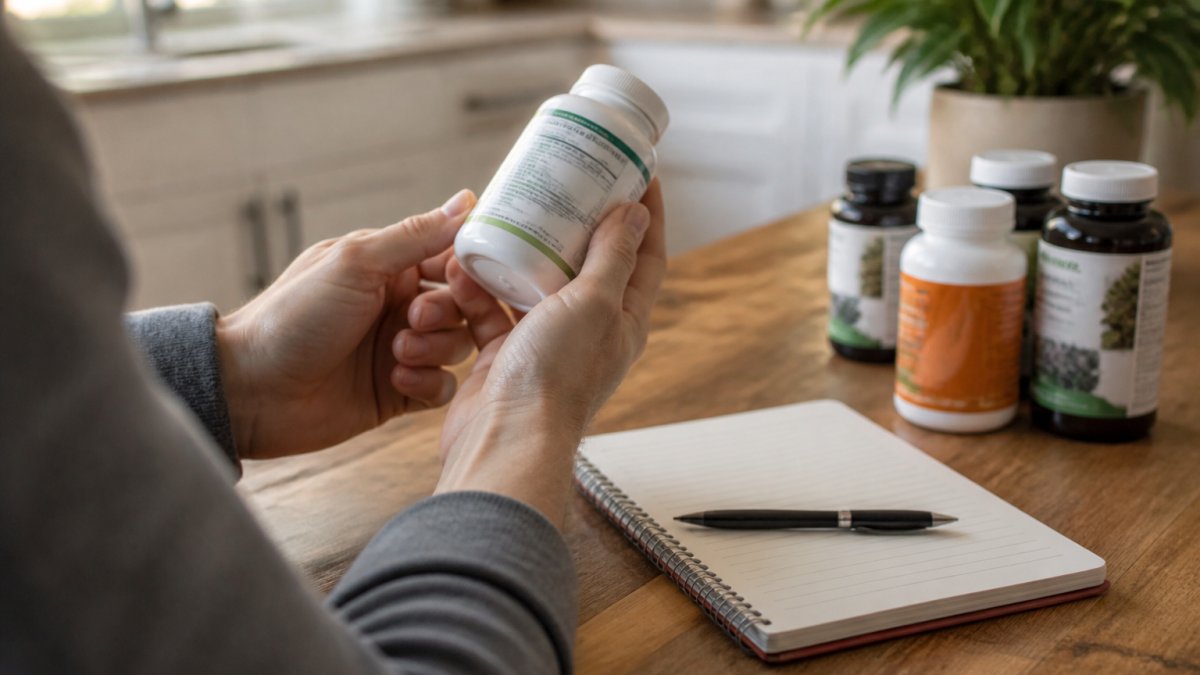
For a deeper walkthrough of vetting safety and quality before you buy, our guide on how to choose safe supplements lays out the full process step by step.
Third-Party Tested Supplements and What the Seal Means
Third-party tested supplements are products whose ingredients or finished batches have been checked by an independent lab rather than only by the company making them.
But a seal is not a magic stamp, and most guides stop at "look for the seal." That advice is incomplete. What matters is what was tested, how often, and whether you can see the evidence.
What a Certificate of Analysis Can and Cannot Tell You
A certificate of analysis, usually called a COA, is the document a lab produces after testing a batch. A useful COA identifies the product and lot number, the tests performed, the methods used, the results, and the date. For a supplement, the tests that matter most fall into three buckets:
- Potency (assay): Does the product contain the amount of each ingredient the label claims?
- Purity and contaminants: Heavy metals such as lead, arsenic, cadmium, and mercury; microbial contamination; and, where relevant, residual solvents.
- Identity: Is the ingredient actually what the label says it is, rather than a cheaper substitute or a diluted form?
What a COA cannot tell you is whether the product works for you, whether the formula is well designed, or whether the ingredient form is the most absorbable one. A COA verifies a batch against a specification; it does not validate the specification itself. A brand can pass every test on a poorly designed formula.
How to Check a Testing Claim in Five Steps
- Ask for the COA by lot number. A real testing program can produce a document tied to the specific batch you bought. A brand that offers only a generic "tested for quality" statement is telling you nothing verifiable.
- Confirm who did the testing. The lab should be independent of the brand. If the "third party" is a subsidiary or a contract manufacturer the brand owns, the independence is cosmetic.
- Check what was tested. Potency alone is not enough. Look for contaminant testing as well, and for identity testing on botanical ingredients, which are the most common target of adulteration.
- Look at frequency. A single batch tested at launch is not the same as every-batch testing. Ask whether the program covers ongoing production.
- Match the seal to its scope. Some certification programs audit the manufacturing facility; others test finished products; others verify only specific claims. Read what the program actually covers rather than assuming the seal means "everything is verified."
The Cost Side of Testing
Every one of those tests is a line item. Potency assays, heavy-metal screens, microbial panels, and identity testing each carry a lab fee, and every-batch testing multiplies that cost across production. That is part of why quality supplements are expensive: the brand is paying for verification you cannot see in the bottle.
For a deeper walkthrough of vetting safety and quality before you buy, our guide on how to choose safe supplements lays out the full process step by step.
Are Expensive Supplements Worth It? A Practical Way to Decide
Expensive supplements are worth it when the extra cost buys something you can name: a better-absorbed ingredient form, documented testing, or a cleaner formula. They are not worth it when the premium is pure branding with no verifiable difference behind it.
Here's the method we'd use to decide, weighing cost against what you actually get:
| What You're Paying For | Worth the Premium? | Why |
|---|---|---|
| Documented ingredient forms | Usually yes | Affects absorption and effectiveness |
| Batch testing and certificates | Usually yes | Verifies potency and purity |
| Clean, short ingredient list | Often yes | Fewer unnecessary ingredients |
| Brand name and packaging | Rarely | No effect on what's inside |
| Celebrity marketing | No | Cost with no product benefit |
Calculate cost per serving, not cost per bottle. If you're weighing the broader question of whether natural supplements earn their place in your routine at all, our guide on whether natural supplements are worth it covers the cost-versus-benefit case in more depth.
Fillers, Additives, and the Cheap-Supplement Tradeoff
Cheap supplements are cheap partly because fillers, artificial colors, artificial flavors, and unnecessary ingredients are inexpensive and make a product easier and faster to manufacture. That tradeoff is the quiet cost of a low price.
Fillers aren't automatically harmful, but they are a signal. Our complete guide to what fillers in supplements are explains each category, and our label-reading guide on how to identify supplement fillers walks through the bottles you already own.
How Supplement Labels and Regulation Shape What You Pay
In the U.S., dietary supplements are regulated as a category of food rather than as drugs, which means products reach the market without the pre-market approval a medication would require. You can read the framework directly through the FDA's dietary supplement guidance and the FTC's rules on health claims in advertising.
What that means in practice is that two bottles can carry similar-looking labels while one brand has invested in testing and documentation the rules do not force on everyone. That voluntary rigor is a real cost, and it shows up in the price. Our guide on why clean label supplements matter explains what that label actually stands for.
Where the Money Actually Goes
Most guides explain that quality costs more without showing the structure of the price. Here is a transparent breakdown of the categories that make up a supplement's retail price. Exact figures vary widely by product, dose, and volume, so treat these as the cost buckets rather than fixed amounts:
- Raw ingredients: Usually the largest single driver. Ingredient grade, documented form, and traceable sourcing all raise this line.
- Testing and quality control: In-house and third-party lab work, including every-batch potency and contaminant testing for brands that do it.
- Manufacturing: Stricter process controls, equipment, and consistency checks cost more per batch than high-speed mass production.
The last bucket is the one to watch. When a premium price is driven mostly by marketing, you are paying for the brand's reach rather than the product. When it is driven by ingredients and testing, the premium has something behind it. The practical move is to ask which buckets a given price is funding, then compare cost per serving rather than cost per bottle.
The Evidence-Based Limit of Premium Pricing
A higher price does not automatically mean better outcomes. Documented quality differences, a more absorbable ingredient form, verified potency, contaminant testing, are real and worth paying for. Marketing claims are not evidence of any of that. The honest position is that premium pricing buys quality only when the premium maps to a verifiable difference, and the regulation framework above is exactly why you have to check rather than assume.
Choosing a Quality Supplement That Fits Your Routine
The best supplement for you is the one whose quality you can verify and whose cost per serving you can justify, taken consistently.
Consistency beats intensity here. A well-made supplement you take daily does more than a premium bottle that sits in the cabinet.
That's where Flu-Jack fits. Our all-natural formulas are built for daily immune system support and healthy circulation, with carefully selected ingredients and no unnecessary extras.
Frequently Asked Questions
Why are some supplements more expensive than others?
Price differences usually come down to raw material grade, how the ingredient is processed, and how much testing the brand runs before a bottle ships. A premium ingredient in its absorbable form, made in a facility that follows current good manufacturing practices, costs more than a mass-market powder with fillers. Packaging, batch testing, and label verification add to that. Cheaper supplements cut costs somewhere, often in ingredient form, purity checks, or the use of artificial colors and unnecessary fillers.
Are expensive supplements worth it?
Not automatically. Price signals investment in ingredients and testing, but it does not guarantee effectiveness. A practical test is to compare cost per serving against the ingredient form, dose, and whether the product is third-party tested. If a premium product uses a better-absorbed form, lists a transparent label, and carries independent testing, the extra cost can be justified. If two products share the same form and dose, the cheaper one is often the smarter buy.
Does third-party testing make supplements more expensive?
It adds cost, yes. Independent testing for potency, purity, and contaminants means paying an outside lab per batch, and that expense is built into the retail price. The tradeoff is verification: third-party tested supplements give you a check on label accuracy that a brand's own internal claims cannot. For buyers, that testing is one of the clearest signals of quality, which is why it is worth paying for when the rest of the formula holds up.
How can you tell if a supplement is high quality?
Start with the label. Look for the specific ingredient form, the amount per serving, and a short list without artificial colors or unnecessary fillers. Check for a third-party testing seal and a current good manufacturing practices statement. Then compare cost per serving rather than bottle price. A brand that publishes testing information and answers questions about sourcing is showing you its quality standards instead of asking you to take them on faith.
The challenge isn't finding a supplement. It's finding one you can trust without a lab coat. Flu-Jack is made for that decision: all-natural formulas, ingredients chosen for immune and circulatory support, and a daily-wellness approach designed to slot into your existing routine. Get started with Flu-Jack and support your everyday health with ingredients you can actually pronounce.