 how-to
How to Identify Supplement Fillers: A Label-Reading Guide
Table of Contents
- What Are Supplement Fillers and Excipients?
- Why Manufacturers Use Fillers and Bulking Agents
- How to Read Supplement Labels for Fillers
- Common Fillers in Supplements to Watch For
- Supplement Ingredients to Avoid
- The Difference Between Functional Excipients and Unnecessary Additives
- How to Choose Third-Party Tested Supplements
- Red Flags: What to Look for on the Label
- Frequently Asked Questions
Last Updated: October 13, 2026
What Are Supplement Fillers and Excipients?
Supplement fillers are inactive ingredients added to supplements to increase bulk, improve texture, or help the product hold together. They serve no nutritional purpose but make manufacturing possible. Without fillers, many supplements would be impossibly small or difficult to produce.
Fillers go by many names. You'll see them called bulking agents, excipients, or other ingredients on labels. The term "excipient" is broader, it covers any inactive substance used in manufacturing, including binders, flow agents, and preservatives.
Here's the key distinction: some excipients are necessary for the product to work. Others are unnecessary additives that cut costs. Learning to tell the difference protects your health and your wallet.
Common fillers include microcrystalline cellulose, maltodextrin, dicalcium phosphate, and starch. Some are harmless plant-based substances. Others may trigger sensitivities or allergies in certain people. The goal of reading labels is to identify which ones are in your supplement and whether they matter for your situation.
Why Manufacturers Use Fillers and Bulking Agents
Manufacturers add fillers for practical reasons. A single dose of some vitamins or minerals is so tiny it's invisible to the human eye. Without bulk, you'd have a capsule that's 90% air. Fillers solve this problem by adding volume.
Fillers also improve manufacturing consistency. When you're pressing thousands of tablets per hour, you need ingredients that flow smoothly through equipment. Pure active ingredients often clump or stick. Fillers like silicon dioxide improve flow and prevent jamming on the production line.
Some fillers improve shelf stability. They absorb moisture, prevent caking, or slow oxidation. This keeps your supplement potent longer. Without these excipients, many products would degrade within weeks.
Cost reduction is another reason, though not always the main one. A filler that costs pennies per batch is cheaper than higher-quality alternatives. Some manufacturers use the cheapest option available. Others choose fillers based on quality and safety, which costs more.
The real issue isn't that fillers exist, it's that some manufacturers use them to cut corners while others use them responsibly.
How to Read Supplement Labels for Fillers
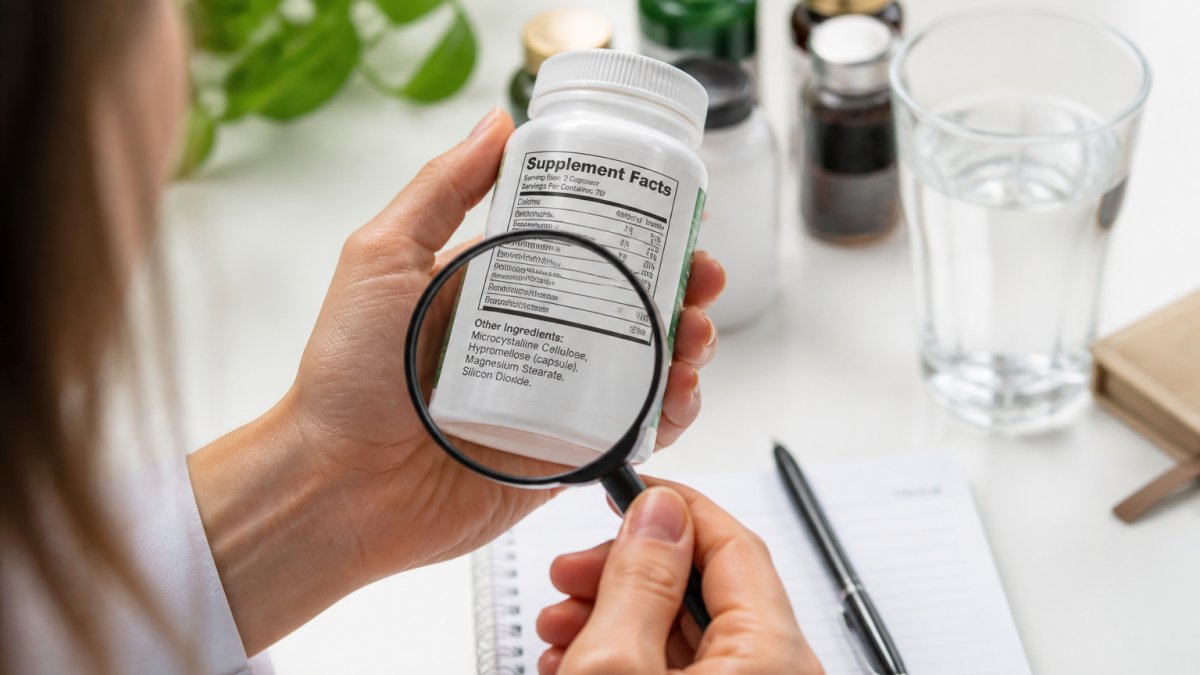
Learning to identify supplement fillers requires reading a supplement label correctly, which takes practice, but the process is straightforward. Most people skip this step and miss red flags entirely. Here's how to do it right.
Step 1: Locate the Supplement Facts Panel
The Supplement Facts panel is the white box on the back or side of the bottle. It lists active ingredients with their amounts in milligrams or micrograms. This is where you start.
Look at the serving size first. Some supplements list tiny serving sizes to make the dose look larger than it actually is. If a multivitamin says "1 tablet" but the label shows 3 tablets per serving, you're getting less of each nutrient than advertised.
Write down the active ingredients and their amounts. These are what you're paying for. Everything below this section is filler territory.
Step 2: Check the 'Other Ingredients' Section
Below the Supplement Facts panel, you'll find a line that says "Other Ingredients" or sometimes "Inactive Ingredients." This is where fillers, binders, and additives live.
Read this list carefully. It's often printed in tiny text, but it's critical. Manufacturers must list every ingredient, including fillers, in order by weight. The first items in the list are present in larger amounts.
If you see 15 items in the "Other Ingredients" section and only 3 active ingredients, the product is mostly filler. That's a red flag. Quality supplements have shorter "Other Ingredients" lists.
Step 3: Identify the Active Versus Inactive Ingredients
The active ingredients are what the supplement claims to do. If the label says "Supports Immune Function," the active ingredients are the ones doing that work, vitamin C, zinc, elderberry, or whatever the formula includes.
Everything else is inactive. Inactive doesn't mean useless, it means it doesn't contribute to the supplement's stated benefit. But some inactive ingredients can cause problems if you're sensitive to them.
Compare the two lists. If active ingredients make up less than 30% of the total weight, you're buying mostly filler. A quality supplement has a higher ratio of active to inactive ingredients.
Common Fillers in Supplements to Watch For
Microcrystalline cellulose is the most common filler. It's plant fiber, generally safe, and helps tablets hold together. Most people tolerate it well.
Maltodextrin is a carbohydrate made from starch. It's cheap, dissolves easily, and adds sweetness. It spikes blood sugar in some people, which matters if you're diabetic or prediabetic.
Dicalcium phosphate is a mineral compound used as a filler and flow agent. It's generally recognized as safe, but some people report digestive upset.
Calcium carbonate appears in many supplements as both an active ingredient and a filler. When used as a filler, it adds bulk cheaply.
Magnesium stearate is a lubricant that prevents ingredients from sticking to machinery. It's present in tiny amounts but appears in almost every supplement.
Silicon dioxide (silica) is an anti-caking agent. It keeps powders dry and flowing. It's safe in small amounts, but some worry about long-term silica exposure.
Hydrogenated oils are a red flag. They're cheap fillers that add unhealthy trans fats. Avoid any supplement listing hydrogenated soybean oil, hydrogenated vegetable oil, or similar.
Starch (often corn starch or potato starch) is a cheap bulking agent. It's fine for most people but problematic if you're sensitive to corn or nightshades. Always check the source.
Supplement Ingredients to Avoid
Certain additives have no place in a quality supplement. These aren't just questionable, they signal that the manufacturer prioritizes cost over your health.
Artificial colors and dyes (like FD&C Yellow No. 5) serve no purpose except appearance. They're unnecessary and trigger reactions in sensitive people. A quality supplement doesn't need bright colors.
Artificial sweeteners like aspartame, sucralose, or sorbitol are common in gummy supplements. They're cheap but unnecessary. If you can't tolerate the natural taste, the supplement isn't worth taking.
Titanium dioxide is used to make supplements white and bright. It's been questioned for safety, especially in powder form. Many manufacturers have removed it.
BHA and BHT are chemical preservatives linked to health concerns in high doses. Natural alternatives like vitamin E work just as well.
Talc occasionally appears as a filler or anti-caking agent. It's a mineral contamination risk and has been linked to health concerns. Avoid it entirely.
Gelatin (from animal sources) appears in capsules and gummies. If you're vegetarian or vegan, look for plant-based alternatives. Gelatin itself is safe but not aligned with plant-based diets.
Soy lecithin is a common emulsifier. If you have a soy allergy or sensitivity, this is a deal-breaker. Many supplements use sunflower lecithin instead, which works just as well.
The Difference Between Functional Excipients and Unnecessary Additives
Not all excipients are bad. Some are genuinely necessary. The trick is knowing which ones earn their place in the formula.
Functional excipients serve a real purpose in manufacturing or stability. Microcrystalline cellulose helps tablets hold together. Magnesium stearate prevents sticking. Silicon dioxide keeps powders dry. These ingredients are present in small amounts and are necessary for the product to work.
Unnecessary additives are there to cut costs or improve appearance without adding value. Artificial colors, artificial sweeteners, and hydrogenated oils fall into this category. They don't improve the supplement's function. They're just cheaper than better alternatives.
The line between the two isn't always clear. Calcium carbonate is necessary in some formulas but unnecessary in others. Starch helps some tablets hold together but is overkill in capsules.
Here's a practical rule: if you don't recognize an ingredient and can't find a reason for its presence, it's probably unnecessary. Reputable manufacturers can explain every ingredient on their label. If you contact them with questions and get vague answers, that's a warning sign.
Quality supplements have shorter ingredient lists with recognizable names. They use the minimum fillers needed to manufacture the product. They avoid artificial colors, dyes, and sweeteners. They use plant-based or mineral-based excipients instead of synthetic chemicals.
How to Choose Third-Party Tested Supplements
Third-party testing is the gold standard for supplement quality. An independent lab tests the product to verify that it contains what the label claims and nothing harmful.
Look for these certification marks:
NSF Certified for Sport means the product has been tested for banned substances and contaminants. It's the most rigorous certification for athletes.
USP Verified (United States Pharmacopeia) confirms that the supplement contains the ingredients listed in the correct amounts. It also checks for contaminants.
ConsumerLab Approved means an independent lab tested the product and verified its contents.
Informed Choice Certified checks for banned substances and verifies label accuracy.
These certifications cost money, so they're more common on premium supplements. But they're worth the extra cost. A third-party tested supplement gives you proof that you're getting what you paid for.
When you see one of these marks, you know:
- The active ingredients are actually present in the amounts listed
- Contaminants like heavy metals are within safe limits
- Fillers are disclosed and present in reasonable amounts
- The manufacturer is willing to stand behind their claims
At Flu-Jack, we prioritize transparency in our all-natural supplement formulas. We use only carefully selected ingredients to support immune function and healthy circulation. Our commitment to quality means you can trust what's in every bottle.
Red Flags: What to Look for on the Label
Certain warning signs indicate a low-quality supplement. Learning to spot them saves you money and protects your health.
Proprietary blends hide ingredient amounts. The label lists ingredients but not how much of each is present.
Vague ingredient names suggest the manufacturer is hiding something. "Natural flavors" could mean almost anything. "Spice blend" could hide allergens.
Missing "Other Ingredients" list is a major red flag. Federal law requires this disclosure.
Extremely low prices compared to competitors usually mean low quality. Cheap fillers, minimal active ingredients, and no quality control are common in budget supplements.
No contact information on the label makes it impossible to ask questions. Quality manufacturers include a phone number or website.
Expired or missing expiration date means the product has been sitting on shelves too long. Supplements degrade over time.
Inconsistent batch numbers across bottles suggest inconsistent manufacturing. Quality control matters. Each batch should be tested and labeled.
Fillers that dominate the ingredient list indicate a product that's mostly bulk with minimal active ingredients.
To identify supplement fillers, you must read labels carefully and understand what each ingredient does.
The supplement industry thrives on confusion. Most people never read labels and assume all supplements are created equal. They're not.
Frequently Asked Questions
What are the most common fillers in supplements?
Common fillers include maltodextrin, microcrystalline cellulose, dicalcium phosphate, calcium carbonate, and starch. These bulking agents add volume to capsules and tablets so manufacturers can fit the active ingredients into a consumable size. While many are generally recognized as safe, some people with sensitivities or specific dietary restrictions may need to avoid certain fillers. Always check the 'Other Ingredients' section on your supplement label to identify what's actually in the product.
How do I know if a supplement has unnecessary fillers?
Compare the active ingredient amount listed in the Supplement Facts panel to the total capsule or tablet weight. If active ingredients make up only 10-20% of the total weight, the product likely contains excessive fillers. Additionally, look for long lists of unfamiliar ingredients in the 'Other Ingredients' section. Reputable manufacturers keep filler content minimal and use excipients primarily for manufacturing consistency, not bulk.
Are all fillers and binders in supplements harmful?
Not all fillers are harmful. Many excipients serve legitimate manufacturing purposes: they improve flow during production, ensure consistent dosing, and maintain shelf stability. However, some individuals may have sensitivities to specific additives like magnesium stearate or silicon dioxide. The key is understanding which fillers are present and whether they align with your dietary restrictions or allergies. If you have concerns about particular ingredients, consult your healthcare provider or look for products labeled as 'filler-free' or verified by third-party testing.
How can I verify that a supplement is third-party tested?
Look for certification logos from recognized testing organizations like NSF International, USP (United States Pharmacopeia), or ConsumerLab on the product label or packaging. These third-party tested supplements have been independently verified for purity, potency, and ingredient accuracy. You can also visit the testing organization's website and search for the product by name to confirm certification status. Reputable brands display these certifications prominently and often provide batch-specific test results on their website, giving you transparent proof that the product contains what the label claims.