 ultimate-guide
What Are Fillers in Supplements: A Complete Guide
Table of Contents
- What Are Fillers in Supplements?
- Why Are Fillers Used in Supplements?
- Common Types of Fillers and Excipients
- Harmful Supplement Additives to Avoid
- How to Read Supplement Labels
- FDA Regulation of Dietary Supplements
- Natural vs. Synthetic Additives: What's the Difference?
- How Fillers Affect Bioavailability and Absorption
- Frequently Asked Questions
Last Updated: October 2, 2026
What Are Fillers in Supplements?
Fillers in supplements are inactive ingredients added to formulations to increase volume, improve texture, or enhance stability without contributing nutritional value. These substances, more formally known as excipients, serve critical manufacturing functions that allow supplement makers to create consistent, stable products consumers can actually take.
The confusion around fillers stems from a fundamental misunderstanding: not all inactive ingredients are problematic. Your supplement needs a binder to hold the tablet together. It needs flow agents so the powder moves smoothly through manufacturing equipment.
At Flu-Jack, we understand that ingredient transparency matters to health-conscious consumers. We prioritize clean formulations with minimal excipients, using only those that serve genuine functional purposes in supporting your immune system and circulation health.
The key distinction lies in understanding which fillers are inert and harmless versus those that may trigger sensitivities or offer no legitimate manufacturing function. Common, safe excipients include microcrystalline cellulose (a plant-derived bulking agent), silicon dioxide (anti-caking), and magnesium stearate (flow agent).
Why Are Fillers Used in Supplements?
Manufacturers use fillers because active ingredients alone cannot be processed into stable, consumable products. Without these supporting materials, your supplement wouldn't function as intended.
Consider the practical challenge: a therapeutic dose of vitamin D might weigh 100 micrograms. You cannot hold 100 micrograms in your hand, let alone swallow it.
Binders hold tablets together during manufacturing and shipping. Without them, your tablet crumbles into powder before it reaches your mouth.
The manufacturing process itself demands these materials. High-speed tableting machines require precise particle flow. Humidity and temperature fluctuations during storage degrade active ingredients without protective excipients.
This is where many supplement companies make their first compromise.
Common Types of Fillers and Excipients
Understanding excipient categories helps you evaluate what you're actually consuming. Most supplements contain three to five different inactive ingredients, each serving a specific role.
Binders and Flow Agents
Binders cement particles together during tableting. Magnesium stearate is the industry standard, a fatty acid that prevents particles from sticking to manufacturing equipment while holding the tablet together. Silicon dioxide serves dual purposes: it prevents moisture absorption and acts as a flow agent, allowing powders to move smoothly through equipment.
Guar gum, derived from guar beans, binds capsule contents and improves texture in powdered supplements. Acacia fiber provides binding while adding prebiotic fiber benefits. These plant-based alternatives work equally well as synthetic binders for most formulations.
Flow agents reduce friction between particles. Without them, manufacturing equipment jams. Stearic acid (a fatty acid) and silicon dioxide both improve flowability. The distinction matters: some manufacturers use excessive flow agents to compensate for poor ingredient quality.
Bulking Agents
Microcrystalline cellulose dominates this category. It's plant fiber processed into fine particles that expand volume without affecting absorption of active ingredients. Your digestive system cannot break it down, so it passes through unchanged, but it serves the essential function of making your supplement swallowable.
Maltodextrin, derived from starch, bulks up powdered supplements while improving mixability. It has a slight sweetness that masks bitter active ingredients. Inulin, a plant fiber, adds volume while providing prebiotic benefits. Silica (silicon dioxide) bulks while preventing moisture absorption.
The quality difference appears in particle consistency. Bulking agents with uniform particle size may require fewer flow agents. Fillers with inconsistent particle sizes may necessitate more additives to achieve proper flow.
Harmful Supplement Additives to Avoid
Some inactive ingredients genuinely warrant caution. These are fillers that serve no legitimate manufacturing function or carry documented sensitivities.
Titanium dioxide, a whitening agent, has raised safety concerns. The FDA restricts it in food coloring but permits it in supplements.
Dicalcium phosphate bulks supplements while providing supplemental calcium.
Artificial dyes (FD&C colors) add no value to supplement formulations. They're purely aesthetic.
Maltitol and sorbitol, sugar alcohols used as sweeteners in chewable supplements, cause digestive distress in many people.
Magnesium stearate itself is safe, but excessive amounts (some formulations use 5-10% by weight) indicate poor ingredient quality.
Cellulose derivatives like hydroxypropyl methylcellulose (HPMC) are generally safe, but some people report sensitivities. Plant-based alternatives like guar gum work equally well.
How to Read Supplement Labels
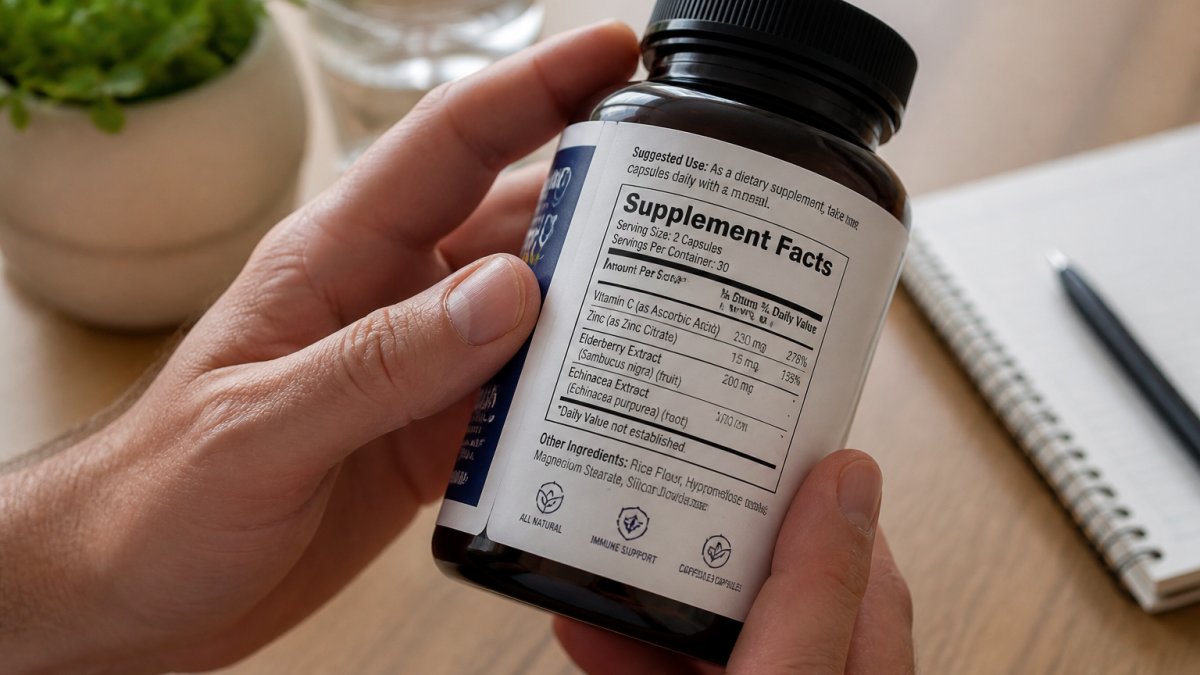
The Supplement Facts label reveals everything about ingredient quality if you know what to look for.
Active ingredients appear first, listed by name with their quantity.
Check the serving size. A supplement claiming 500mg of an active ingredient per serving must list that quantity clearly.
Excipients should be recognizable. Microcrystalline cellulose, silicon dioxide, magnesium stearate, guar gum, these are standard, safe materials. Unknown chemical names warrant research.
Look for third-party testing claims. Seals from NSF International, USP, or ConsumerLab indicate independent verification that the product contains what the label claims. Many supplements fail these tests, containing less active ingredient than advertised or containing unlisted contaminants.
Allergen declarations matter. Labels must disclose major allergens (milk, eggs, fish, shellfish, tree nuts, peanuts, wheat, soy, sesame).
FDA Regulation of Dietary Supplements
The FDA regulates dietary supplements under the Dietary Supplement Health and Education Act (DSHEA), which treats supplements differently from drugs. This distinction shapes what manufacturers can claim and what testing they must conduct.
Under DSHEA, supplement manufacturers are responsible for ensuring their products are safe before marketing them. The FDA does not pre-approve supplements the way it pre-approves medications (the FDA). This places the burden on manufacturers to validate safety and on the FDA to prove a product is unsafe before removing it from the market, a reactive rather than proactive system.
Manufacturers cannot claim supplements treat, cure, or prevent disease. They can claim supplements "support" or "promote" health functions, but these claims must have competent scientific evidence.
Excipients themselves fall under FDA oversight. The agency maintains a list of "Generally Recognized as Safe" (GRAS) substances approved for food and supplement use. Most common fillers, microcrystalline cellulose, magnesium stearate, silicon dioxide, hold GRAS status.
The Current Good Manufacturing Practice (cGMP) standards require supplement manufacturers to maintain quality control during production (the FDA). These standards cover facility cleanliness, equipment maintenance, and testing procedures. However, enforcement varies, and many smaller manufacturers operate with minimal oversight.
This regulatory gap explains why third-party testing matters. The FDA's testing is complaint-driven rather than systematic. Independent labs fill this gap by testing products for potency, purity, and contamination.
Natural vs. Synthetic Additives: What's the Difference?
The distinction between "natural" and "synthetic" excipients is more marketing than science.
Microcrystalline cellulose is plant-derived but requires chemical processing to achieve the fine particle size needed for manufacturing. It's technically natural but heavily processed.
Magnesium stearate can be derived from animal fats (natural) or synthesized chemically (synthetic). The final molecule is identical.
Synthetic flow agents like silicon dioxide are chemically identical to naturally-occurring silica. The manufacturing process differs, but the end product is indistinguishable.
Natural alternatives sometimes introduce new problems. Natural preservatives like rosemary extract work but impart flavor.
The real distinction lies in necessity, not origin.
Flu-Jack formulations prioritize active ingredient potency and bioavailability, using whichever excipients, natural or synthetic, serve those goals most effectively.
How Fillers Affect Bioavailability and Absorption
Bioavailability, the percentage of an active ingredient your body actually absorbs, depends partly on formulation design.
Bulking agents like microcrystalline cellulose are inert. They don't interfere with absorption because your digestive system ignores them completely. They pass through unchanged.
Binders can affect dissolution rate, how quickly the tablet or capsule breaks down in your stomach.
Certain excipients enhance absorption. Guar gum slows gastric emptying, giving your digestive system more time to absorb active ingredients.
Flow agents like silicon dioxide can actually improve absorption by preventing clumping. Clumped supplements dissolve poorly, reducing bioavailability.
The problem emerges when manufacturers use excessive fillers to cut costs.
When evaluating supplements, the presence of fillers itself isn't the concern. Every legitimate supplement contains them.
Frequently Asked Questions
What fillers should I avoid in supplements?
Avoid talc, titanium dioxide (in high doses), artificial dyes (FD&C colors), and certain silicates. Magnesium stearate and silicon dioxide are generally recognized as safe by the FDA in small amounts, but some prefer to minimize them. Check your label for these names specifically. If a supplement lists 'proprietary blend' without ingredient breakdown, that's a red flag. Look for third-party testing seals from NSF or USP to verify what you're actually getting.
Are all supplement additives harmful?
No. Most excipients are safe in the quantities used in supplements. Binders like microcrystalline cellulose and flow agents like silicon dioxide help ensure consistent dosing and shelf stability without posing health risks for most people. The concern arises when fillers make up a large percentage of the pill or when they're questionable substances like artificial dyes. The FDA regulates dietary supplements, and approved excipients have safety data behind them. Context matters, a small amount of magnesium stearate is different from a capsule that's 40% filler.
How do I know if a supplement has too many fillers?
Check the ingredient list order. Ingredients are listed by weight, so if fillers appear in the first few positions, the supplement is mostly additives. Compare the active ingredient amount (listed in milligrams) to the total pill weight. If a 1000 mg tablet lists only 100 mg of active ingredient, the rest is fillers and excipients. Third-party testing reports often break this down. Reputable brands disclose their full formula and explain why each ingredient is included.
Do natural supplements have fewer fillers than synthetic ones?
Not necessarily. 'Natural' supplements still need binders and flow agents to hold a pill together and ensure consistent dosing. The difference is in the source: natural binders like acacia fiber and guar gum come from plant sources, while synthetic ones like microcrystalline cellulose are lab-created but still FDA-approved. Both can be effective. What matters more is transparency, a brand that lists every ingredient and its purpose, whether natural or synthetic, can help consumers make informed choices.