 how-to
How Do You Check If a Supplement Is Third-Party Tested?
Last Updated: November 4, 2026
Quick Summary
Check for third party testing by finding a certification seal on the label that names an independent organization, then look up the exact product in that organization's public database. Confirm the name, form and current status match your bottle. A seal alone is not proof.
- Third party testing means an independent lab, not the manufacturer, checks the product against published standards.
- Read the label for a named certifying organization and a registration number, not just a logo or generic wording.
- Search the certifier's public database for the brand, product name, form and serving size, and compare them with your bottle.
- Check that the listing is current, since certifications can lapse or change over time.
- GMP certification describes the facility's processes, so it does not prove a specific product's ingredients match its label.
Table of Contents
- What Third-Party Testing Means for Supplements
- Why Third-Party Certification Matters for Your Family's Routine
- Step-by-Step: How to Check a Supplement's Certification Status
- Finding Third-Party Tested Supplements Online
- Understanding GMP Certified Supplements and What They Do Not Prove
- Telling Real Seals From Counterfeit Ones
- Checking Your Next Flu-Jack Order Against These Standards
- Frequently Asked Questions
Most people who buy a supplement never check whether anyone ran a third party testing review on it. The label might say "natural" or "clinically inspired," but that word alone tells you very little about what is inside the bottle. Checking for third-party testing takes about ten minutes, and it is one of the most useful habits a health-conscious buyer can build. This guide walks you through what the testing means, how to read certification seals, and how to verify a product's status yourself.
What Third-Party Testing Means for Supplements
Third-party testing is when an independent laboratory, not the company that makes or sells the product, checks a supplement against published standards. The lab looks at whether the label is accurate, whether the product contains what it claims in the amounts it lists, and whether it contains contaminants such as heavy metals or banned substances.
A company testing its own product is called internal testing. It can be useful, but the results come from the same organization that benefits from a good outcome. Third party testing removes that conflict.
Here is the basic difference:
| Testing Type | Who Runs It | Main Question It Answers |
|---|---|---|
| Internal testing | The manufacturer's own staff | Did our quality checks pass? |
| Third-party testing | An independent lab | Does the product match its label and standards? |
Independent testing does not guarantee a supplement will work for you. It only shows that the product is what the label says it is, which is a separate question from effectiveness. For a broader primer on why clean, verified labels matter, read why clean label supplements matter.
Why Third-Party Certification Matters for Your Family's Routine
If you buy supplements for yourself, an unverified product is a gamble. If you buy for a household, the stakes rise. Children, older parents and people on prescription medicines may react differently to unlisted ingredients or inconsistent doses.
Certification adds a layer of accountability. Certified products have been reviewed against a standard, and that review can repeat over time rather than happening once.
The main risks of unverified supplements include:
- Label mismatch: the bottle lists one amount, but the product contains more or less.
- Contamination: heavy metals or microbes that were never listed on the label.
- Hidden ingredients: substances that do not appear on the panel at all.
Step-by-Step: How to Check a Supplement's Certification Status
Follow these steps before you buy, or when you pick up a bottle you already own.
- Read the front and back of the label for seals. Look for the name of a recognized certification program.
- Note the exact product name, brand and lot number. Certification often applies to a specific formula, not to every product a company sells.
- Search the certifier's public database. Most programs publish lists of certified products you can search.
- Match the product details. Confirm the name, the form (capsule, powder, gummy) and the version listed in the database match your bottle.
- Check the status date. Certifications can lapse or change, so confirm the product is currently listed.
If a product carries a seal but cannot be found in the database, treat that as a warning sign and contact the company before buying.
Reading Certification Seals on the Label
A certification seal is a logo that a program allows a company to print once a product passes its review. Seals are easy to see on the packaging, but they are also easy to copy, so a seal alone is not proof.
When you read a seal, look for:
- The name of the certifying organization printed clearly, not only a logo
- A reference to a specific standard or program
- A registration or certificate number you can look up
Be cautious of generic wording such as "tested for quality" or "lab verified" with no named organization behind it. For a practical guide to reading labels and spotting filler ingredients, see how to identify supplement fillers. These phrases are not the same as an independent certification.
Searching the NSF and USP Verified Supplements List
Two of the most widely recognized programs in the United States are NSF International and USP. Both publish searchable lists of products that have met their standards.
To check a product:
- Go to the program's official website and find the product or supplement search tool.
- Enter the brand name first, then the product name.
- Compare the product's form, serving size and ingredient panel with the listing.
- Save or screenshot the listing for your records.
Official lookup tools change over time, so confirm the current search method on each organization's own site rather than relying on a saved link.
Finding Third-Party Tested Supplements Online
Shopping online makes verification harder because you cannot read the bottle in person. Use these habits when buying from a website:
- Look for a clear statement of testing on the product page, not just in marketing copy.
- Check that the certifying organization is named and that you can look up the product yourself.
- Compare the lot or batch information on the product page with the certifier's records when that information is available.
- Be wary of product pages that rely on customer reviews while leaving out any testing details.
Understanding GMP Certified Supplements and What They Do Not Prove
GMP stands for Good Manufacturing Practices (the FDA). These are guidelines for how a facility should make, package and store products so that quality stays consistent. A GMP certification tells you about the facility's processes.
It does not tell you that a specific product's ingredients match the label, or that the product is safe or effective for your needs. A GMP-certified factory can still produce a product that has never been independently tested for potency or contaminants.
Use GMP as one piece of your check, not the whole check. The strongest signal is a product-level certification that names the specific formula you are buying.
Telling Real Seals From Counterfeit Ones
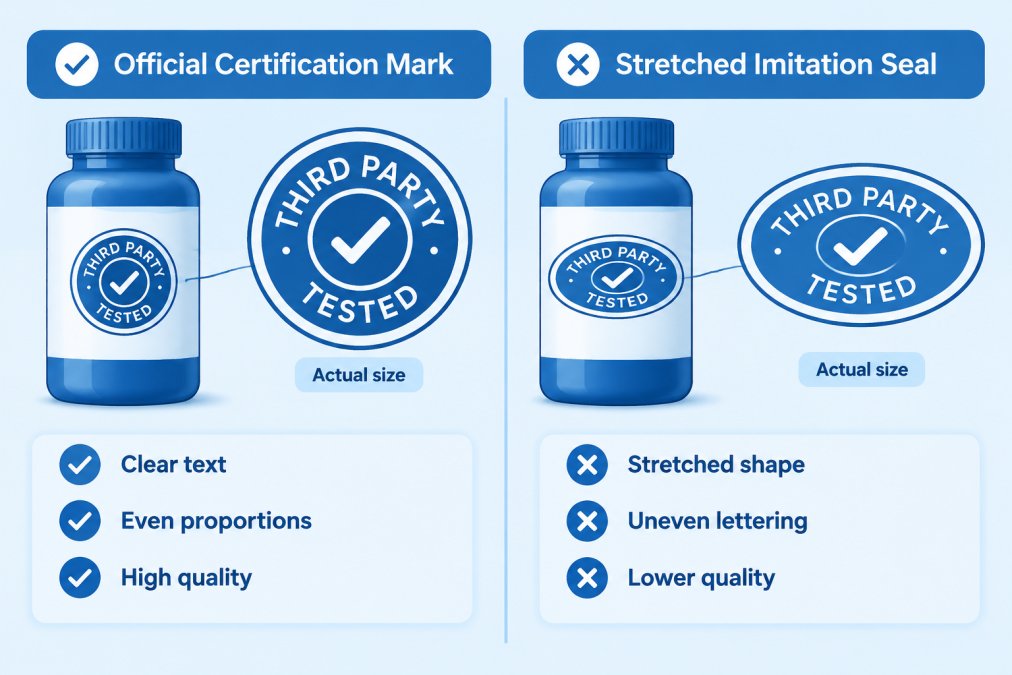
Counterfeit seals fall into two categories, and they require different checks. The first is a copied logo, a company prints a certifier's mark without authorization. The second, and more common, is a misleading mark, a logo that looks official but belongs to no accredited program at all. The database check catches both, but you can screen for them before you ever open a browser.
How to compare a seal against the official mark
Certifiers publish their marks on their own websites, which gives you a reference image to compare against. Pull up the official mark and check:
- Proportions and spacing. Copied logos are often stretched, squeezed or re-colored, and the letter spacing inside the mark is frequently off.
- The full organization name. A real mark names the certifying body in legible type. A logo alone, with no organization name anywhere on the label, is a warning sign.
- The program name. NSF Certified for Sport, NSF/ANSI 173 and USP Verified are distinct programs with distinct marks. A seal that blends two program names, or invents a variation, is not a real mark.
- The certificate or registration number. Many programs print a number the company can be asked to produce. A seal with no number and no named organization is decorative, not certified.
The misleading-mark pattern
A common pattern is a circular badge with a checkmark, the words "lab tested" or "quality verified," and no organization name. These marks are designed to borrow the visual language of certification without making a claim anyone can check. Treat any seal that cannot be traced to a named, accredited organization as unverified, regardless of how official it looks.
Watch out: a seller who displays a certification logo in product photos but cannot produce a certificate number, or who responds to a request for one with a generic statement about quality, is the clearest signal that the mark is not backed by a program.
Cross-check the seal against the database
The packaging is the claim; the database is the evidence. Once you have the organization name and any certificate number, run the lookup described above. If the product is not listed, the seal does not count, no matter how convincing it looks on the bottle.
What to do when a seal fails the check
If a product carries a seal that does not survive the database check, stop and document what you found: photograph the label, note the lot number and the seller, and report the product to the certifier whose mark was used. Certifiers take unauthorized use of their marks seriously, and a report is often the fastest way to get a misleading listing removed. Then return the product if the seller's policy allows it, and choose a product whose certification you can confirm.
Checking Your Next Flu-Jack Order Against These Standards
Before you place your next order, run through the checklist above. You can view the Flu-Jack Anti Viral product line to check its labeling against these standards. For a framework to compare products before ordering, see how to choose safe supplements.
Frequently Asked Questions
How do I know if a supplement has been third-party tested?
Look for a seal from an independent certifier such as NSF International or USP on the label, then confirm it. Both organizations publish searchable databases of verified products. Enter the brand and product name, and check that the listed formula and dosage match the bottle you own. A seal alone is not enough if you cannot find the product in the database, since seals can be copied. Lot-specific testing results are rarely published, so the certifier's listing is the most reliable place to confirm status.
Does a GMP certified label mean a supplement has been independently tested?
Not necessarily. GMP stands for Good Manufacturing Practices, the FDA's baseline rules for how facilities make and handle products. A manufacturer can claim GMP compliance based on its own audits. Independent third-party testing is a separate step in which a lab checks the product's contents against its label. Some brands carry both, so read the seal and check whether it names an outside certifier. A GMP claim without a named third party should be treated as a manufacturer statement rather than verified testing.
What is the difference between third-party testing and third-party certification?
Third-party testing means an independent laboratory analyzes samples of a product for contaminants, potency, or label accuracy. Third-party certification goes further: the certifier also audits the manufacturing facility and tests products over time to confirm ongoing compliance. Certification usually requires a renewal process and can be withdrawn. When you check a seal, confirm whether it represents a one-time test or an ongoing certification program, since the two offer different levels of assurance.
Can I verify an NSF or USP certification myself?
Yes. Visit the NSF Certified for Sport or NSF Product Certification database, or the USP Verified Mark directory, and search by brand or product name. Compare the listed ingredients and serving size with your bottle. Note the registration or certification number if it appears. If a brand claims NSF or USP status but cannot be found in the database, contact the certifier directly or choose another product.